A Gaian civilization may appear weak in the beginning, but it has a strong defense and economy.
Strengths []
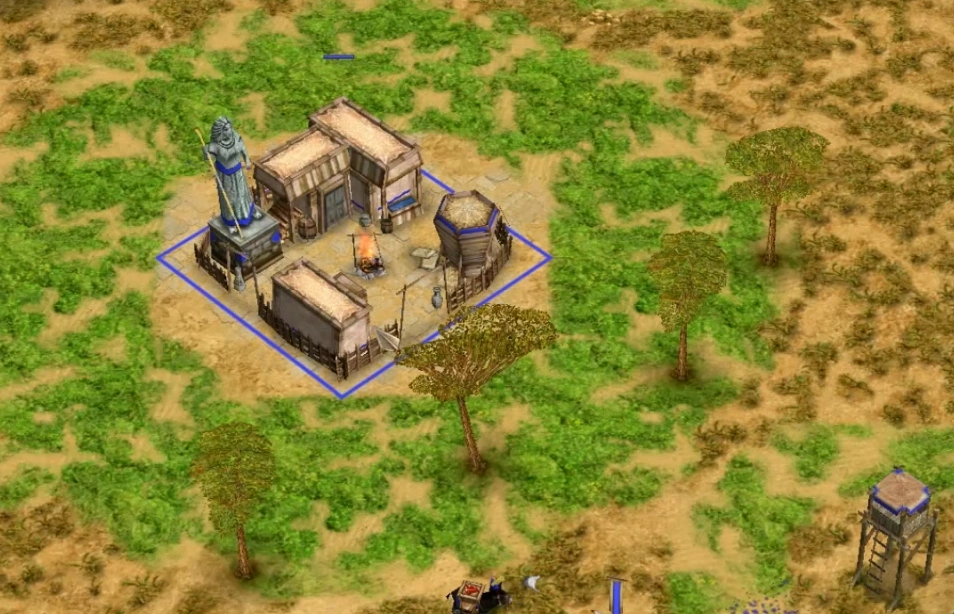
Gaia's stronger, cheaper Llama Caravans and Fishing Ships are less prone to raiding as they are more durable and can be replaced cheaply if killed. The Channels technology makes Citizens move faster, meaning that they can escape from enemy attacks more easily. Gaia also allows buildings to regenerate, making them survive longer and almost removing the need for repair. Her buildings also generate lush terrain, restricting enemies from placing buildings near her cities. Even if an enemy destroys a Town Center in the middle of an important base, they will be forced to clear out every single one of her buildings in the vicinity as the lush also prevents building new Town Centers. Her god power, Gaia Forest, can be used defensively by arranging it to create a wall. This is especially true on maps with narrow passages, such as Jotunheim. Gaia is probably one of the best gods for turtling and boom strategies in Age of Mythology.
Gaia's economic bonuses are formidable. Faster Citizens can move between resources more quickly, meaning there is even less 'dead time.' Along with Fishing Ships and Caravans, all economic bonuses are cheaper too. This adds up to a large saving of resources over the course of a game. She also provides bonus wood (like Thor's Dwarven Mine) with her Gaia Forest god power. On more arid maps such as Savannah, this amounts to a significant benefit.
Finally, Gaia is highly valuable as an ally in online games. The lush does not prevent the construction of allied buildings, so players can supplement their allied bases with a few buildings to keep enemies from building nearby. Worshiping Oceanus in the Classical Age grants Gaia players a Caladria, which can also heal the units of allied players who lack a dedicated healer. The wood provided by Gaia's forests can also be shared with allies who need it more, but can also be used in combination with Freyja's Forest Fire god power.
Weaknesses []
Gaia is regarded by competitive players as one of the weakest Major Gods in Age of Mythology, alongside Odin. Her scouting abilities are the weakest of the Atlantean Gods as her Oracles lack any speed benefits that would increase their usefulness in the early game. Although Gaia's buildings can regenerate, it is at a very slow rate so repeated attacks (particularly from siege weapons) will destroy them before their HP is fully replenished. Her most notable weakness is that she also lacks Prometheus or Hyperion in her Minor God roster so overall her heroes are always going to be more expensive and less durable. This means that Gaia worshipers will not be capable of fending off myth unit attacks as easily as players who have chosen Kronos or Oranos.